
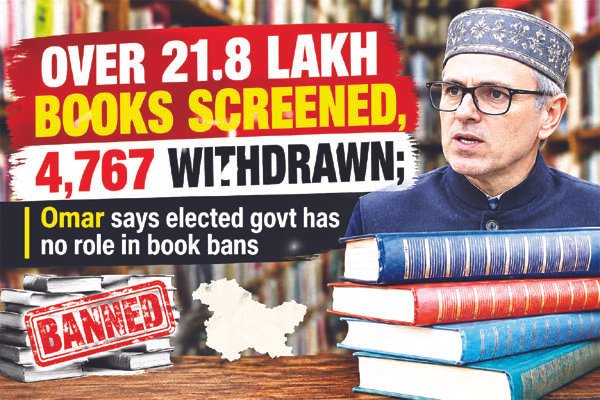

Over 21.8 lakh books screened, 4,767 withdrawn; Omar says elected govt has no role in book bans
Srinagar/Jammu, Sept 24: The withdrawal of 4,767 books and publications from colleges across Jammu and Kashmir has opened up another window into the unusual power arrangement in the Union Territory, with Chief Minister Omar Abdullah saying the elected government has no role in deciding which books should be banned.
The Higher Education Department informed the Legislative Assembly that 21,81,582 books and publications had been examined across J&K. Of these, 9,32,941 were screened in Jammu division and 12,48,641 in Kashmir.
The government said 4,767 books had been withdrawn from circulation, including 518 banned publications.
While 293 books were withdrawn in Jammu division, the figure was 4,474 in Kashmir.
Another 1,752 books—538 in Jammu and 1,214 in Kashmir—have been referred for expert examination. The scrutiny process is continuing.
In the context of J&K, the government said a clear and objective criterion had been adopted for identifying objectionable material, maintaining that higher educational institutions are expected to uphold constitutional values, academic freedom, critical thinking, scientific temper, responsible citizenship and respect for the sovereignty, unity and integrity of India.
The scrutiny followed directions issued in July 2026 to screen books in educational institutions after controversy over the procurement of books containing objectionable material in the school textbooks.
Omar raises larger question over authority
The political dimension emerged when Omar Abdullah was asked about the withdrawal and alleged banning of books.
The Chief Minister said he had his own views on whether books should be banned but maintained that, under the present administrative arrangement, his government does not decide such matters.
“I have my own views on whether books should be banned or not,” adding that the issue could be reconsidered if the administrative arrangement changed. He, however, did not comment on the objectionable contents in the textbooks.
His remarks have brought the book controversy into the wider political debate over the division of powers between the elected government and the Lieutenant Governor’s administration.
The National Conference-led government has repeatedly sought restoration of full statehood to J&K, arguing that the present Union Territory arrangement restricts the authority of the government elected by the people.
Under the Jammu and Kashmir Reorganisation Act, 2019, the Legislative Assembly does not have legislative power over Public Order and Police, while the Act also specifies areas in which the Lieutenant Governor exercises discretion. The elected government, nevertheless, remains responsible for the functioning of departments and development-related sectors falling within its domain.
The resulting arrangement has periodically produced political friction over the respective authority of the Chief Minister and the LG administration.
Chief Secretary backs scrutiny
Chief Secretary Atal Dulloo, meanwhile, said checking books was a regular process and that banned books should not be kept in government schools.
Asked about reports of large numbers of books being banned and whether more titles could be listed, Dulloo said any banned books should not remain in government educational institutions.
The contrasting positions have given the controversy a wider political dimension. While the administration has stressed enforcement of restrictions on banned material, the Chief Minister has questioned the role of the elected government in taking such decisions.
The issue now also raises questions about the transparency of the scrutiny process, including disclosure of the titles withdrawn, the grounds for their classification and the authority under which individual decisions were taken.
For J&K, therefore, the book controversy is not merely about what students can read. It has once again exposed the unresolved question at the heart of the Union Territory’s governance structure: how authority is to be exercised between an elected government with a popular mandate and a Lieutenant Governor vested with powers under the Re-organisation Act.