
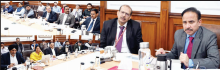

Spl Secy reviews progress with CS; Urges UT to set national benchmarks
Jammu Tawi, Nov 18: Special Secretary, Cabinet Secretariat, Government of India, K.K Pathak on Wednesday appreciated Jammu and Kashmir’s progress in implementing deregulation reforms, observing that several initiatives undertaken by the Union Territory could serve as models for other States and Union Territories.
Pathak, who heads the Centre’s Task Force on Deregulation and Compliance Reduction, made these observations while co-chairing a review meeting with Chief Secretary Dr. Sajjan Singh Yadav to assess progress under Deregulation 1.0 and 2.0.
Appreciating the administration’s commitment, Pathak urged J&K to move beyond nationally prescribed benchmarks and establish a more progressive, business-friendly regulatory environment.
He advocated a risk-based regulatory framework, suggesting self-certification for low-risk activities, third-party certification for medium-risk sectors and mandatory regulatory oversight for high-risk activities.
He also emphasised assessing the actual reduction in compliance requirements, procedural delays and costs following implementation of reforms.
Chief Secretary Dr. Yadav directed departments to organise stakeholder workshops and awareness campaigns to familiarise businesses, institutions and citizens with the benefits of regulatory simplification.
He stressed that the success of deregulation should be measured through tangible public benefits rather than merely issuing notifications and government orders.
Commissioner Secretary, Industries and Commerce, Vikramjit Singh briefed the meeting on progress achieved across various sectors.
He informed that under Deregulation 1.0, 20 Priority Areas had been accepted as implemented, while two were declared not applicable.
Under Deregulation 2.0, 11 Priority Areas had been accepted as implemented, nine implemented areas were awaiting approval, and eight others remained under implementation, including five being addressed through the J&K Ease of Doing Business Act, 2026.
The meeting reviewed reforms involving removal of dual licensing requirements, simplification of Legal Metrology procedures, streamlined industrial approvals and self-declaration mechanisms for MSMEs.
Amendments to the J&K School Education Rules, 2010, aimed at simplifying infrastructure and certification requirements for private schools, were also discussed.
Other initiatives included rationalisation of fire safety norms, healthcare licensing procedures, professional registrations and regulatory requirements for higher educational institutions.
The Homestay Policy, aimed at promoting affordable tourist accommodation, also figured during the review.
Dr. Yadav reiterated the administration’s commitment to strengthening institutional coordination, monitoring implementation and ensuring that deregulation reforms deliver meaningful benefits to entrepreneurs, institutions and citizens across Jammu and Kashmir.